
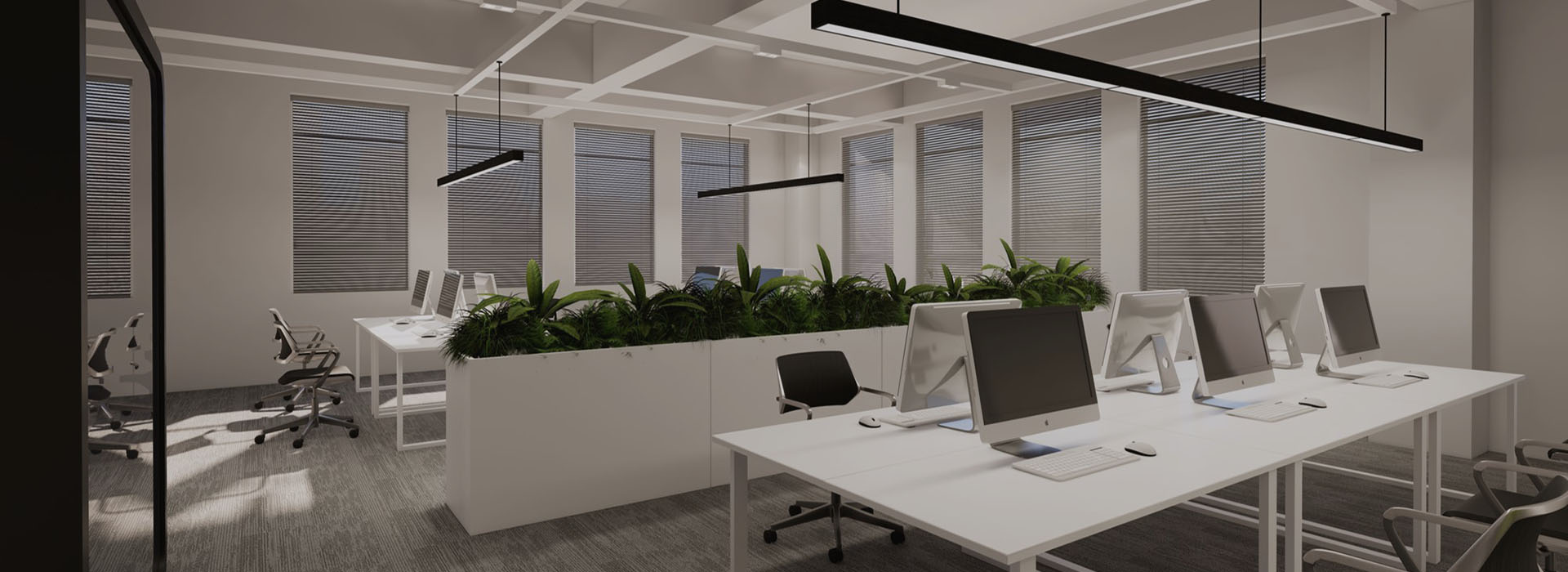
Office decoration is not only related to spatial aesthetics, but also directly affects office efficiency and corporate image. Scientific budget planning and rigorous construction plans are the core of project success, and the two need to work closely together to achieve a balance between functionality and aesthetics while controlling costs. This article will systematically sort out the key points of office decoration from budget breakdown, scheme design to construction implementation, providing practical reference for enterprises.
1、 Budget planning: precise disassembly, dynamic control
(1) Budget components
The budget for office decoration needs to cover four major modules: hard decoration engineering, soft decoration configuration, equipment procurement, and other expenses. The proportion of each module varies depending on the needs of the enterprise (such as technology companies focusing on intelligent equipment and cultural and creative enterprises focusing on soft decoration design). Generally, hard decoration accounts for 40% -60%, soft decoration accounts for 20% -30%, equipment accounts for 15% -25%, and other expenses are reserved for 5% -10%.
1. Hard decoration engineering: including space demolition and renovation (body demolition, new construction), water and electricity renovation (strong and weak electrical wiring, water supply and drainage), wall and floor (latex paint, floor tiles/wooden flooring), suspended ceiling (gypsum board, aluminum buckle board) and other basic engineering. It should be noted that the cost of water and electricity renovation in old buildings is usually 20% -30% higher than that of new construction spaces, and concealed works need to be surveyed in advance.
2. Soft decoration configuration: including office furniture (workstations, conference tables, storage cabinets), decorations (curtains, green plants, art installations), lighting fixtures (pendant lights, eye protection lights), etc. It is recommended to prioritize the purchase of ergonomic furniture to enhance employee experience, and the budget can be tilted towards high-frequency workstation chairs and conference systems.
3. Equipment procurement: air conditioning, fresh air, office equipment (printers, projectors), intelligent systems (access control, monitoring, lighting control), etc. If central air conditioning is used, it is necessary to confirm with the property management in advance the location of the external unit and the direction of the pipeline to avoid later rectification.
4. Other expenses: design fees (usually 5% -15% of the total budget, with independent designers charging more than the decoration company's package design), supervision fees (3% -5%, to ensure construction quality), emergency reserves (5%, to cope with material price increases and design changes).
(2) Budget preparation method
1. List pricing method: List items item by item based on "project+quantity+unit price", suitable for personalized decoration. For example: demolition of walls (120 yuan/m '), water and electricity renovation (80 yuan/m), solid wood flooring (280 yuan/m'). Please note that the list should clearly indicate the material brand and model (such as "Dulux Bamboo Charcoal Latex Paint" instead of "Latex Paint") to avoid adding items later on.
2. Area estimation method: Estimate the total budget based on the decoration level (simple decoration yuan/m ", fine decoration yuan/m ', luxury decoration above 3000 yuan/m'). This method needs to be adjusted according to the actual needs of the enterprise, for example, the intelligent equipment of technology companies will raise the unit price.
3. Priority sorting method: Divide the requirements into "essential items" (such as fire protection renovation, separation of strong and weak electricity), "optimization items" (such as intelligent lighting, soundproof ceiling), and "optional items" (such as art installations, high-end carpets), prioritize the essential items, and then flexibly adjust the optimization items according to the budget
(3) Key points of budget control
Market research: Compare quotes from 3-5 suppliers, with a focus on material cost-effectiveness (such as a price difference of up to 50% between domestic latex paint and imported brands, but with similar environmental performance). Elastic pre sealing: Reserve 10% of emergency funds to address hidden issues discovered during construction (such as the need to replace all old circuits due to aging).
Requirement anchoring: To avoid "excessive design", non reception oriented enterprises can simplify front desk decoration and allocate budget to optimize sound insulation and lighting in employee office areas.
2、 Construction plan: Process management, refined implementation
(1) Pre preparation: Closed loop from requirements to solutions
1. Requirement research: Collaborate with administrative, IT, HR and other departments to clarify functional requirements (such as the number of open workstations, independent meeting room area, and load-bearing requirements for the computer room). For example, law firms need to set up sound proof negotiation rooms, and Internet companies need to reserve enough power sockets and network ports.
2. Design plan: Professional designers will create drawings based on requirements, including floor plan layout, renderings, and construction drawings (water and electricity direction, ceiling keel diagram). The plan needs to be approved by the fire department (such as the width of evacuation routes and the spacing between sprinkler heads) to avoid rectification after construction.
3. Construction approval: Submit the decoration plan to the property management, apply for the construction permit, and file for garbage disposal. If it involves structural renovation, a structural safety certificate issued by the design institute is required.
(2) Construction phase: Control quality step by step
1. Demolition and foundation engineering:
Demolition project: Mark concealed pipelines (such as air conditioning copper pipes and fire pipes) and use dust-free dismantling to reduce dust pollution.
Water and electricity renovation: Separation of strong and weak electrical pipes (spacing>30cm), water pipes running on the top for easy maintenance, and uniform height of sockets (office area 30cm above ground, conference table 1.2m above ground)
Waterproof engineering: Conduct 24-hour closed water test in the bathroom and pantry, and ensure drainage with a ground slope of>3%.
2. Mud tile and decorative engineering:
Tile laying: using the "dry hard cement mortar" process to avoid hollowing; Large sized tiles (such as 800x1600mm) need to be thinly pasted with tile adhesive.
Wall treatment: Before applying latex paint, apply 2-3 coats of putty, with an interval of at least 24 hours between each coat, to ensure a smooth wall surface.
Ceiling installation: The spacing between light steel keel should be less than 40cm, and V-shaped grooves should be made at the joints of gypsum board to prevent cracking.
3. Installation and Closing Engineering:
Furniture entry: Install large furniture (such as filing cabinets and conference tables) first, then place workstations to avoid collisions.
Equipment debugging: Conduct a 24-hour trial run of the air conditioning and fresh air system to test the cooling/heating effect and noise levels; Perform stress testing on network devices (simulating the bandwidth load of multiple people working simultaneously).
Clean delivery: All construction waste will be cleared and thoroughly cleaned three times (after fine excavation and soft installation) to ensure that pollutants such as formaldehyde meet the standards (refer to GB standards)
(3) Acceptance stage: Multidimensional quality verification
1. Sub item acceptance: After the completion of the hydropower project, use a "phase meter" to detect the socket wiring and pressure test the water pipe (pressure>0.8MPa, stable for 30 minutes without pressure drop); Mud tile engineering uses a "ruler" to detect the flatness of the wall surface (error ≤ 3mm)
2. Overall acceptance: Invite the design, supervision, and usage departments to conduct joint acceptance, focusing on checking the spatial functionality (such as the acoustic effect of the conference room and the load-bearing capacity of the computer room) and aesthetics (such as the color difference of the walls and the alignment of furniture).
3. Rectification and delivery: Rectify the acceptance issues one by one, issue a "Rectification and Acceptance Form", and provide the "Decoration Completion Drawing", "Equipment User Manual", and "Hidden Engineering Photo Archive" upon final delivery
3、 Collaborative optimization of budget and construction: the core strategy for cost reduction and efficiency improvement
(1) Cost oriented design scheme
Material substitution: Using imitation marble tiles instead of natural stone reduces costs by 60% and simplifies maintenance; Replacing solid wood grilles with aluminum square ceilings for better fire resistance performance
Process simplification: The complex irregular ceiling is replaced with a flat top and partial shape, reducing the construction period by 30% and the cost by 20%.
Space reuse: The conference room also serves as a training room, and the number of independent rooms can be reduced by flexibly adjusting the space through moving partitions.
(2) Cost control of construction changes
Change approval: Any design changes must be approved by the budget team and evaluated for their impact on the project schedule and costs (such as adding an office, which requires an additional investment of 150000 to 200000 yuan and a 10 day extension of the project schedule)
Visa management: Changes proposed by the construction party (such as adjusting the demolition plan if there are steel bars inside the original wall) must be signed on site and the cost bearing party must be clearly identified.
(3) The implicit benefits of construction optimization
Centralized material procurement: Bulk purchases of materials such as latex paint and ceramic tiles from the same brand can receive a discount of 5% -10%.
Technological innovation: Adopting the "thin pasting method" for tiling, reducing cement usage, increasing construction speed by 40%, and reducing wall hollowing rate by 90%.
Time management: Adopting "interspersed construction" (such as synchronously customizing furniture during water and electricity construction), the total construction period is shortened by 15% -20%, indirectly saving rental costs,
4、 Summary: Closed loop thinking from budget to construction
Office decoration is a value creation under budget constraints, which requires demand as the anchor point (clarifying core functions), budget as the ruler (dynamically controlling costs), and construction as the carrier (refined implementation plan). Enterprises can create practical and branded office spaces while controlling budgets through the model of "professional team+process management+collaborative optimization". It is recommended to review the decoration investment and usage experience every quarter to accumulate data for subsequent upgrades and iterations, so that the space can continue to serve the development of the enterprise.